
I think a lot of people fail to understand the business model of modern large food retailers. It is the same model in Canada, the USA, in Europe, anywhere. In Canada, large food retailers are extremely consolidated.

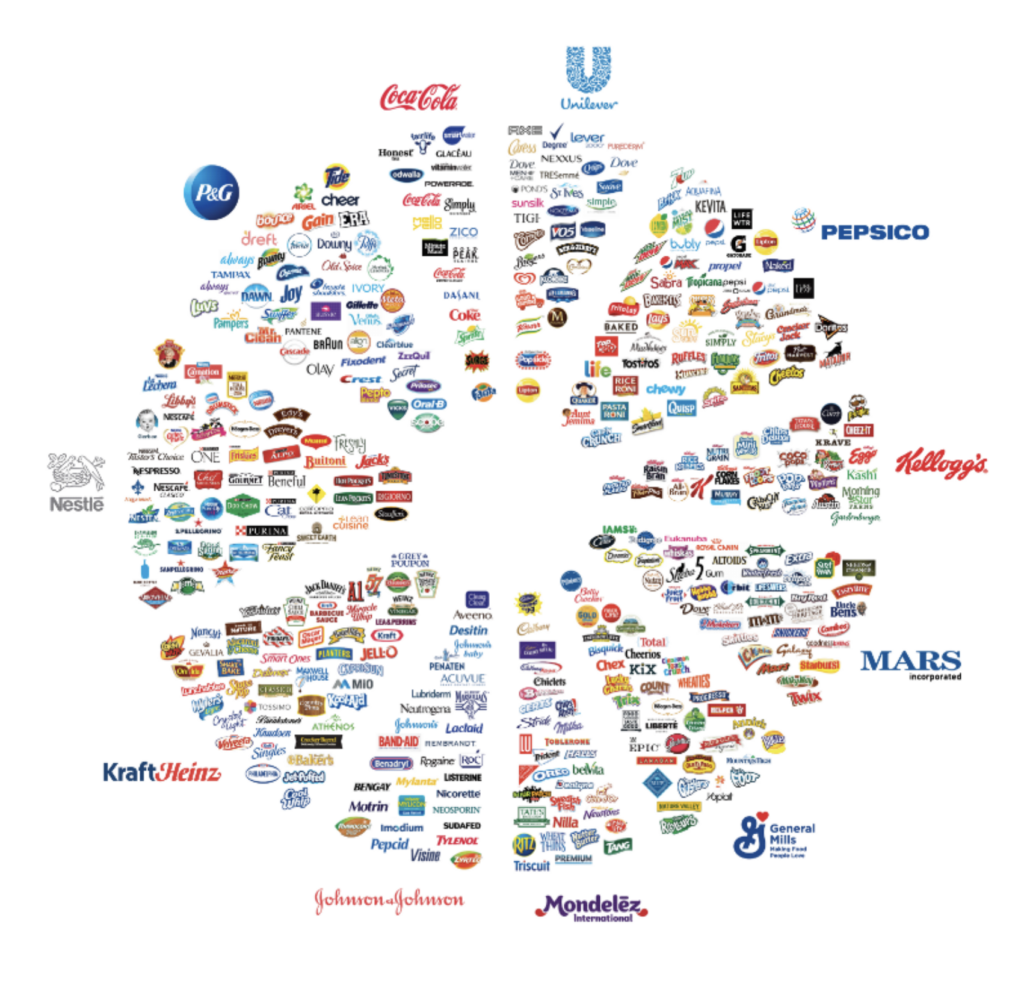
Similarly, the global CPG (Consumer Packaged Goods) landscape is also extremely consolidated.
The contemporary food retailer business model
What people think the business model is: The food is the product, and you are the consumer. People think that large consolidated food retailers succeed because they can use their scale to bring you superior products at lower prices than a smaller company can. At worst, they may use their scale to engage in anti-competitive business practices to drive smaller retailers out of business and consolidate power, or collude as happened in the infamous Canadian bread price-fixing scandal.
What their business model really is: You are the product, and Consumer Packaged Poods conglomerates (CPGs) are their real customer. They sell to packaged food companies product placements in online and physical stores to packaged food companies, and surveil you both online and in physical stores to sell data about you to packaged food companies. In this regard, Loblaws, Sobeys and Metro act more like a social network selling ad placements and ad performance data than a small independent grocer selling food.
Imagine you are shopping online, and you search for an ingredient. Which brand is featured at the top of your search? The brand has paid for those search results. Imagine you bypass those paid search results and purchase a brand you are loyal to, but then they are out of the product and they swap in a new brand, that swap may have been paid for too. Now next time you shop, they offer to sell you the swapped brand again as a repeat purchase. That may have been paid for by the new brand as well. Most importantly, they dynamically adjust the price for each individual according to what their advanced algorithms think you will pay based on their massive data set about you and others they think are similar to you. Electronic price labels in store can adjust the price of an item on a shelf thousands of times a day, mirroring the power that food retailers have to manipulate your product feed and product prices as you shop extract the most money from both you and the CPG.
There’s sponsored product ads throughout the experience and the idea is you don’t even realize it. We’ve had sponsored products on our sites for a couple of years now and nobody seems to notice. – Lauren Steinberg, Loblaws Digital. [reference]
Surveillance Patterns for Food Retailers
In order to fully mirror the price manipulation power of a user logged in to an online site, the store must also be able to identify you and track your shopping behaviours. In physical stores, that is why you must identify yourself with their loyalty card in order to get the better prices. Large food retails make more money selling data about you to packaged food companies than they do jacking the prices for people who choose not to be tracked by the loyalty card. But facial recognition will probably make loyalty cards obsolete at some point. I suspect that these advanced humanless checkout techniques are less about saving money on cashiers and more about surveillance. If they can use AI to track you in-store as you add items to your shopping basket, they can also track your emotional sentiment at the moment you choose what brand to buy and sell that data to the brands. I am not alleging that this is happening today at scale, but this is most likely the next step. Loblaw’s Digital does have a 1000+ army of data engineers working on capturing and monetizing all this data. This data is not only sold to packaged food companies and other external parties, it is used to dynamically adjust prices higher or lower depending on what price their data determines you can bear. The price on the shelf may dynamically change as you approach it if the store is equipped with electronic pricing tags, or they may just charge you a different price at checkout than was displayed on the shelf. For more information about surveillance pricing, see this article.
This is not a uniquely Canadian problem, Amazon is the world leader at collecting user data for use in unscrupulous ways. Amazon’s foray into Whole Foods, Amazon Go and Amazon Fresh were a massive experiment in leveraging surveillance and AI to maximize profit. In order to enter these stores, you had to identify yourself with a QR code that linked your face to your profile and the cameras would begin to surveil you, ostensibly for the convenience of not having to check out, but the amount of data that was collected in-store was deeply concerning.
Of course, if you are shopping online, every action is surveilled by default. Unlike Europe, Canada has relatively weak privacy and consumer protection laws. In Canada you do not have to opt in to be surveilled and there is no obligation for companies to make a best effort to provide equal services to those who opt out of surveillance.
From Data Collection to Data Sharing
Once you start looking at the big three Canadian food retailers as data companies, I think we need to understand that data companies make more money when they share their data. Of course this data is valuable to their business, but is it valuable to other businesses and actors in contexts other than food? Some questions that we should ask are:
- What are the terms and conditions of using their rewards programs?
- What are the terms and conditions of using their websites?
- What are the terms and conditions of using apps that they would have you install on your phone? What data is being collected from the location sensors, the cameras and microphones on that phone.
- Are there adequate privacy regulations in Canada, and are they being enforced?
- Who is this data being shared with?
- What can this data be used for by itself? What can this data be used for when combined with data from other sources, like social media?
Canadian companies are already in the spotlight for sharing data with ICE. We know that ICE & Palantir are eager to process data from any source that will sell it to them. Thompson Reuters is best known in Canada for being a media company based in Toronto, but their primary business focus has shifted to being a data company. Their Consolidated Lead Evaluation and Reporting (CLEAR) database compiles data from public records, phone records, utility records, social media information, credit history, motor vehicle registration data, and automatic license plate reader scans. CLEAR has been the subject of numerous lawsuits alleging invasions of privacy and other violations of civil liberties, particularly in relation to ICE. This underlines an urgent reevaluation of our willingness to allow our data to be collected and shared by any company, especially for an act as essential as food shopping.
A different model for online shopping
I would say that a good solution to bring down food prices in this brave new digital world would be to have a separation of concerns between the intermediary representing the food shopper and the intermediary representing the food producer or brand. I would argue that a structural change to the industry where we could ensure that an ecosystem of food stores that act in the best interest of consumers would do much more to lower food prices online.
Imagine for a moment a standardized open protocol that would allow small food brands to sell their products on an open marketplace. Imagine a food coop that could scan this marketplace and curate products on behalf of the shopper using this open protocol. On one side of this protocol there is a marketer is looking to get the highest price or the highest volume sales for the brand, and the other side are stores looking to get the lowest price for the shopper. This is how things used to work when there was an ecosystem of independent food wholesalers and buyers. My grandfather was one such independent food wholesaler, as a child I grew up surrounded by forklifts running palates of fresh produce destined for independent grocery stores across the city. We were eventually pushed out of business when Safeway vertically integrated it’s supply and consolidated it’s hold on the market.
When you have one platform representing both sides of the equation, there is an inherent conflict of interest, and the platform will drive down brand revenues and drive up food prices to capture more revenue. Cory Doctorow calls this the Amazon Tax, and claims it is as high as 50% regardless of whether you shop on Amazon or not. This relationship is further confused when retailers start offering their own brands to compete with independent brands. I strongly suspect that this lack of an ecosystem of independent operators is what is driving food inflation in Canada. This isn’t the fault of the retailer, they are in business to make money, and the less they pay for their product and the more they can sell it to you, the more profit they make. We just need to restore some balance to the system.
For further reading, check out Cory Doctoraw’s scathing review of Amazon, it is enlightening. I highly recommend his book on the subject.
Public Markets and Food Co-ops: Different models for in-store shopping
There are many precedents for crafting radically different ways to connect food sellers and food buyers. I grew up in Vancouver, where the Canada Housing and Mortgage Corporation, a government entity, owns and operates Granville Island Public Market, which was an absolutely magical place that a modern food retailer simply cannot replicate. Similar markets exist in most Canadian cities. The St Lawrence Market in Toronto, the Byward Market in Ottawa, Marché Atwater and Marché Jean-Talon in Montréal are all more than tourist destinations, they are central to the urban fabric of these cities. I currently live in Portugal, where each borough of Lisbon has a government run Mercado, many of which are struggling to be honest, but some of which have been invigorated with a flush of private investment under new management. The world famous TimeOut Market in Cais du Sodré is expanding from Lisbon to New York and Paris. Government intervention created space for these markets to provide not only a market for small independent farmers and fishers and butchers and bakers to sell their products at a fair price, but also to give people the opportunity to buy good healthy food at a reasonable price. It doesn’t always work out as planned, but it is a business model that has huge potential when done correctly.

Consumers can also band together without government help to create co-ops, as happened in Vancouver when Vancity provided a customer run banking co-op to fill the gaps left by Canada’s big 5 banks. I was a founding member of the Mountain Equipment Co-op, which provided Vancouverites with reasonably priced and ethically sourced outdoor gear for decades before it lost it’s way. Similar organizations can form on the supplier side as well, such as the privately run Ontario Food Terminal which sees over a million trucks of fresh produce through it’s gates annually.
These ideas continue to have relevancy today, Toronto City Councillor Anthony Perruzza’s proposal to have Toronto City own and run public food retailers has passed and been adopted by Toronto City Council. I look forward to seeing how this may develop in the future.
Solutions not band-aids.
I would like to call out the Canada Groceries and Essentials Benefit for low income Canadians as a band-aid that does very little to address the structural issues causing food inflation in Canada. In the end, this benefit is nothing more than an indirect subsidy for these large food retailers to continue doing what they are doing with impunity. Canada needs better privacy laws and to put an end to anti-competitive behaviour of our food retailers. It needs to leverage federal legislative and budgetary power to foster an fair and independent ecosystem of food producers and retailers that can respond to the diverse and dynamic needs of all Canadians, not just shove a cheque in people’s wallets to spend at the same 3 retailers on the same global CPG products.
Elbows-up means creating an environment where all Canadians are free to start small businesses at any point in the chain to compete with our massive food industry south of the border, not funnel more money into three retail conglomerates that collude with that massive American food industry. In many sectors of the economy we see the same patterns. Banking and finance are dominated by our big 5 banks. Internet is provided by Rogers, Bell, or Telus. When you travel, you can choose from either WestJet or Air Canada and your products are transported on rail by either CPKC or CN. There has to be more to elbows-up than choosing a Canadian monopolist over an American one.
However, the despite the blatantly populist Canada Groceries and Essentials Benefit, the Liberals under Mark Carney seem to understand these issues and to be doing the less sexy work of addressing the structural issues I call out in this post. Canada’s new National Food Strategy earmarks $1 billion dollars to expand the Ontario Food Terminal and replicate it as regional hubs to help foster an ecosystem of independent retailers. There is also money to help small and medium size retailers modernize and compete, and money for local greenhouse and hydroponic startups and even for smaller food processors. This plan should help re-establish an independent ecosystem of farmers, distributors, wholesalers, and retailers to get healthier, fresher, less processed food into Canadian fridges in the next decade. By increasing competition and choice at all points from farm to table, this plan should reduce food costs for all Canadians. In essence, the current liberal government is applying both band-aids and real solutions.
In conclusion
As consumers, we have the responsibility to understand the business models of where we shop, and we have agency on how we choose to spend our money. If we are not satisfied with value we are getting from our big three Canadian food retailers, we have options. Shop with knowledge and intent.