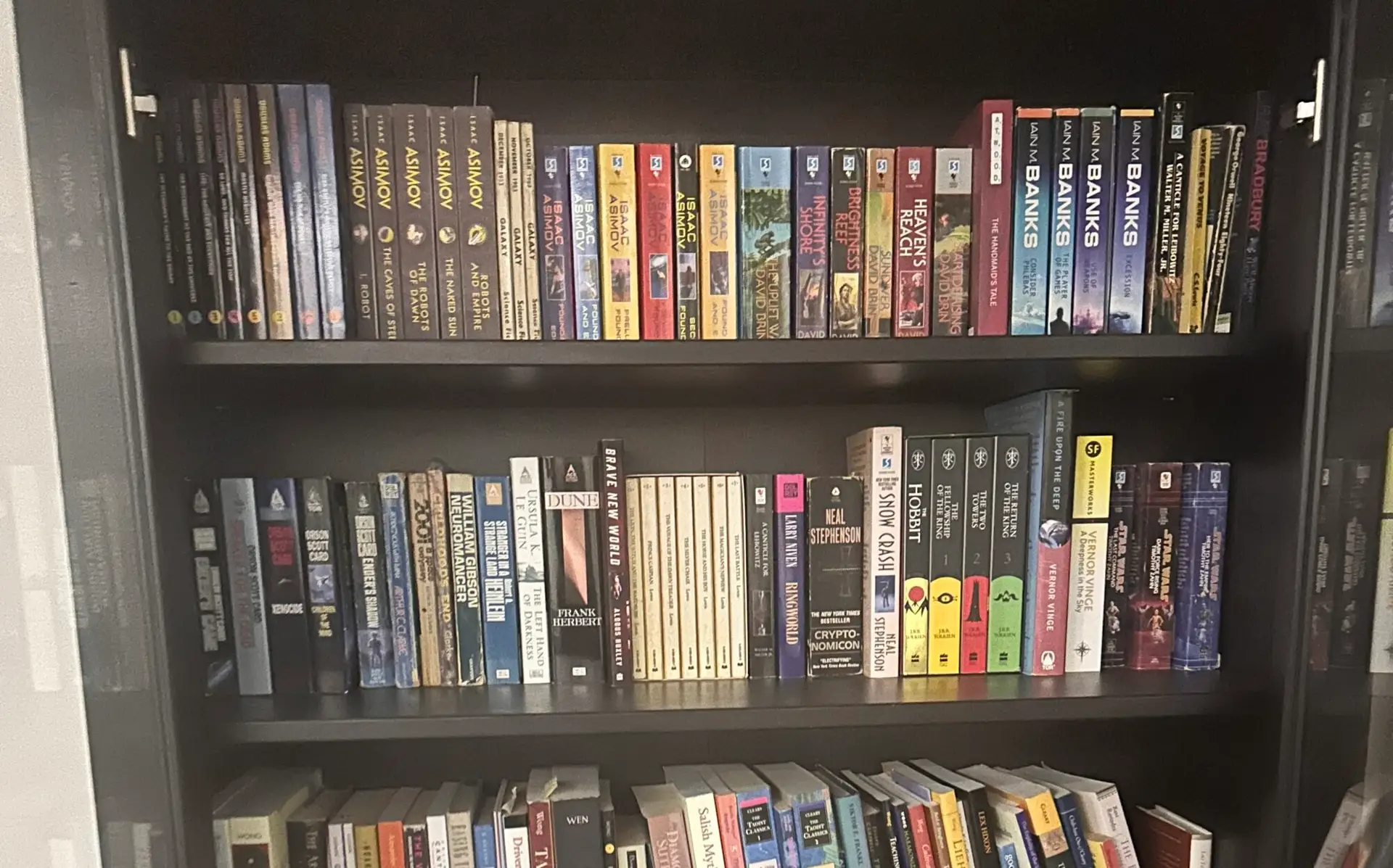
Science fiction is not the only genre I read. I enjoy other types of fiction. Nor do I only read fiction. In fact, I would say that I have a habit of alternating one fiction book with one non-fiction book. It is often the non-fiction books that I enjoy the most, but I do believe that science fiction is a good counterbalance to non-fiction because it expands the mind and allows for creative imagination of better worlds.
People often misinterpret science fiction as fiction that is set in the future, but nothing could be farther from the truth. Some of the most famous science fiction is set in the present or even the past. Star Wars opens with “a long time ago in a galaxy far, far away.” Some people prefer the term “speculative fiction,” and although I don’t use the term regularly, I do like the idea that the premise that the foundation of of science fiction is to take all of the laws of the universe and change one, and build a plot around that change. That doesn’t apply to all science fiction, but it certainly is a better definition than “set in the future.
I think people underestimate the power of fiction, especially science fiction, and how much it resonates for people who are involved in technology careers, where traditional religions don’t resonate for everyone (a large majority of tech workers tend to be agnostic, atheist, or otherwise humanist).
The brain is still hardwired for mythologies, and whether it be through film or the printed word, and science fiction has a unique ability to deeply resonate with people who do not have a traditional religion. The science fiction reader will suspend their disbelief and be transported to an alternate universe, but the moment the last page is turned, the reader reverts to their secular, atheist, mundane life. However, the universes to which we were temporarily transported become part of our brain’s wiring and leave a lasting effect on our worldview, just as any mythology will. Science fiction may be the mythology of our times.
This is not only by my personal experience, and my experience interacting with other like minded people, but also by the tech oligarchs who have read the same books that the rest of us have, although they have sometimes have been affected in radically different ways by these books. In fact, it is shocking to see some objectively evil tech oligarchs quoting dystopian books , and rather than trying to prevent the dystopian future, they accelerate us towards it.
Jeff Bezos and Elon Musk regularly cite Isaac Asimov’s Foundation series as formative to their worldview and view their mission as to prolong its enlightened phase and spread it beyond the planet. Mark Zuckerberg lifted the word “metaverse” directly from Snow Crash by Neal Stevenson, and Neal Stevenson was even on Jeff Bezos’s Blue Origin project as an early advisor. SpaceX’s drone ships were named after the Culture ships in Ian M. Banks’s Culture novels, so it’s safe enough to assume that Elon Musk is a fan of the Culture novels. Two of those ships are “Just Read the Instructions” and “Of Course, I Still Love You.” Even Neuralink’s Neural Lace has been lifted from the Culture universe. Even Jeff Bezos and Mark Zuckerberg are also often cited as fans of the Culture novels. Musk et al are constantly quoting The Hitchhiker’s Guide to the Galaxy by Douglas Adams, as do a significant segment of tech workers. Rumor has it that Musk even included a copy of Hitchhiker’s Guide to the Galaxy in the glove box of the Tesla Roadster that he launched into space. Tech villain Marc Andreessen has made Ender’s Game by Orson Scott Card mandatory reading at several of his startups, and Jeff Bezos modeled Alexa after the computer in Star Trek. Dune is often also cited by tech oligarchs when talking about resource economics and the long-term thinking required for their plans.
On the flip side, authors such as Ian M. Banks and Douglas Adams are fairly skeptical of tech billionaires, and the affection is usually one-way. Regardless, one cannot underestimate the effect that these novels have had on contemporary society, influencing the tech oligarchs and their workers, all be it in different ways.
I therefore have endeavoured to make a list of the most influential science fiction, as a starting point for conversations about the genre so that I can learn about new things to read. This list was developed as an attempt by me to define what is the canon of the body of work called science fiction that is most representative of the genre, but is heavily skewed the idiosyncrasies of my own warped personality. (Whether I was attracted to these books because my personality came pre-warped, or whether these books warped me is also up for debate).
- These are all books that I have read at some point in my life and have left a deep impression. That means that there are books geared towards children that were popular in the ’80s and early ’90s, and it also means that there’s heavy influence from my childhood and current friends who are also heavily into the genre.
- In books, as in music and film, I have a certain affinity for trilogies or series, because it takes time to develop a universe and to explore that universe from multiple angles. The more books there are in a series, the more developed the universe becomes and the more it can resonate with depth.
- In generating this list, I pulled from other lists such as past Nebula and Hugo award winners. More importantly, I looked at various maps of all of the subgenres of science fiction and fantasy, at where there were concentrations of books that I liked and adjacent subgenres that I had perhaps ignored, and looked for canonical books to plug those gaps and find new things to read.
- I’ve shared this list with a few science fiction authors and aficionados, and they have suggested a few additions which have made it into this list.
So, without much further ado, the list:
| Title | Author | Universe |
| 1. The Hitchhiker’s Guide to the Galaxy 2. The Restaurant at the End of the Universe 3. Life, the Universe and Everything 4. So Long, and Thanks for All the Fish 5. Mostly Harmless | Douglas Adams | I was obsessed with these books as a teenager. The science fiction genre is an excuse for Douglas Adams to craft absurdities that support some of the wittiest dialogue and one-liners in all classic British humour. Ask any technical person my age the significance of the number “42” and they will all give you the same answer. |
| 1. I Robot 2. Caves of Steel 3. The Robots of Dawn 4. Robots and Empire | Isaac Asimov | The Three Laws of Robotics provides an excellent construct for the plots of these novels. 1. A robot may not harm a human or allow one to come to harm through inaction. 2. A robot must obey human orders unless that conflicts with the first law. 3. A robot must protect its own existence unless that conflicts with the first two laws. However it is the contrast between the crowded “Caves of Steel” of future Earth and the self-enforced isolation of the 50 spacer worlds that I found most fascinating in these novels. |
| 1. Prelude to Foundation 2. Forward the Foundation 3. Foundation 4. Foundation and Empire 5. Second Foundation 6.Foundation’s Edge 7. Foundation and Earth | Isaac Asimov | The concept of “psychohistory” amplifies the plots of these novels to mythological levels. A profound yet extremely entertaining series. |
| 1. The Handmaid’s Tale 2. Testament | Margaret Atwood | This feminist dystopian book was assigned reading in my Grade 12, but Margaret Atwood was consulting producer of a television series during it’s production 2017-2025. This authoritarian universe set in the very near future and recent political events make it all the more chilling. Margaret Margaret Atwood is a Canadian treasure. |
| 1. Consider Phlebas 2. The Player of Games 3. Use of Weapons 4. The State of the Art 5. Excession | Iain M. Banks | The Culture is a Utopian universe. This is Fully Automated Luxury Gay Space Communism at it’s best, a fantasy world where AI manages everything and humans worry about nothing and it actually works. Also, I find these to be an easy read, as Banks’s writing style is very approachable. |
| 1. Sundiver 2. Startide Rising 3. The Uplift War 4. Brightness Reef 5. Infinity’s Shore 6. Heaven’s Reach | David Brin | The Uplift Universe is based on the idea that evolution is tightly managed by patron species who uplift client races into a hierarchical civilization where every species knows it’s place. The discovery of sentient humans who evolved with no patron causes much drama, often violent, when first contact is made with various factions in the hierarchy. In order to be perceived as valid in the hierarchy, humans hurriedly uplift dolphins and help them explore space in water filled spaceships. A slightly challenging read due to the sheer number of alien races. |
| 1. Ender’s Game 2. Speaker for the Dead 3. Xenocide 4. Children of the Mind 5. Ender’s Shadow | Orson Scott Card | The Enderverse is actually not that interesting to me, it’s just a classic alien invasion story but very well told and expanded to extents that are only possible in novels. I would have liked this universe more had I read it as a teenager rather than as an adult, but I understand why so many people insisted I include it in this list. It is objectively good science fiction writing. |
| 1. Childhood’s End 2. 2001: A Space Odyssey | Arthur C. Clarke | Arthur C. Clarke wrote 2001:A Space Odyssey at the same time as the movie script. A lot of people don’t actually understand this plotline and get confused at the end, but I find that if one reads Childhood’s End first, it’s easier to understand the premise and what is happening, therefore I will call these a series although it’s highly unconventional. |
| Neuromancer | William Gibson | William Gibson actually used to come into a café where I used to work in Kerrisdale, Vancouver, and write at a table in the back of the café. This is the OG cyberpunk novel that launched the genre. It is also the origin of the term “cyberspace.” I read this when it came out in 1984, but I believe it stands the test of time. |
| Stranger in a Strange Land | Robert A. Heinlein | In 1961, this book is just simply a good read. |
| Dune | Frank Herbert | the Dune universe is probably one of the more well-known universes after Star Trek and Star Wars, but it is vastly greater in scope. I’m only including the first Dune book because I find these books to be extremely long and extremely time-intensive; however, if I had more time, I would read all of them. I think there are parallels between the Dune universe and the Foundation universe by Isaac Asimov, but the emotional quality and moral focus of these books is entirely different. Dune serves almost as a counterpoint to the Foundation universe. I also greatly enjoyed the 1984 film by David Lynch, as well as the current films directed by Canadian Dennis Villeneuve |
| Brave New World | Aldous Huxley | This was assigned reading for me in Grade 12, but this dystopian novel is a good companion to 1984. Together, they are almost an inoculation against fascism, and I wish more people read them at a young age. |
| The Left Hand of Darkness | Le Guin | |
| A Canticle for Leibowitz | Walter M. Miller, Jr. | This may be my favourite science fiction novel of all time. Although it is packaged as one book, it is actually a trilogy, set thousands of years apart. This book deals with nuclear war from a very unique angle and, quite oddly, has the Catholic Church as a protagonist. |
| Ringworld | Niven | This is classic science fiction, and the universe itself is not absolutely fascinating, but it is a very well-written and a most excellent read. There are other books in this universe, but I’ve only read Ringworld. |
| Nineteen Eighty-Four | George Orwell | Better known than A Brave New World by Aldous Huxley, 1984 is the canonical dystopian authoritarian universe. It is more relevant today than when it was written. |
| Snow Crash | Stephenson | The Snow Crash universe is a libertarian’s wet dream, where corporations have taken over all functions of government, and the nation state is no more. I wouldn’t call this book strictly dystopian, but it definitely explores issues of corporatism that I find very apropos today. |
| 1. The Hobbit 2. The Fellowship of the Ring 3. The Two Towers 4. The Return of the King | Tolkien | Although personally I’m not a fan of fantasy books, these are the canonical fantasy books, and I must include them. Credit to my friend Mary Watts who in Grade 10 informed me that The Hobbit was a children’s book and, if I wanted to be an adult, I had to continue on to read the actual trilogy, which I managed with great effort. |
| A Fire Upon the Deep | Vinge | I will admit this is a very challenging read because most of the species and artificial intelligences in these books share some type of telepathic or electronic distributed consciousness, so writing almost never occurs in the first person. However, if anyone ever wants a terrifying description of what a singularity event might look like, the opening chapters of this book will send shivers down your spine. |
| 1. Heir to the Empire 2. Dark Force Rising 3. The Last Command | Timothy Zahn | I saw Return of the Jedi in theaters as a very young child and have been captivated by the Star Wars universe ever since. Apparently, I’m not alone. The Expanded Universe contains so many novels, and it is hard to keep track. Quality of writing in the Expanded Universe varies, but this trilogy by Timothy Zahn is widely accepted as the best of the Expanded Universe has to offer, and has been considered for adoption into the official Star Wars canon by George Lucas himself. These books are absolutely fantastic. |